Fifth Cell Therapy Insights event
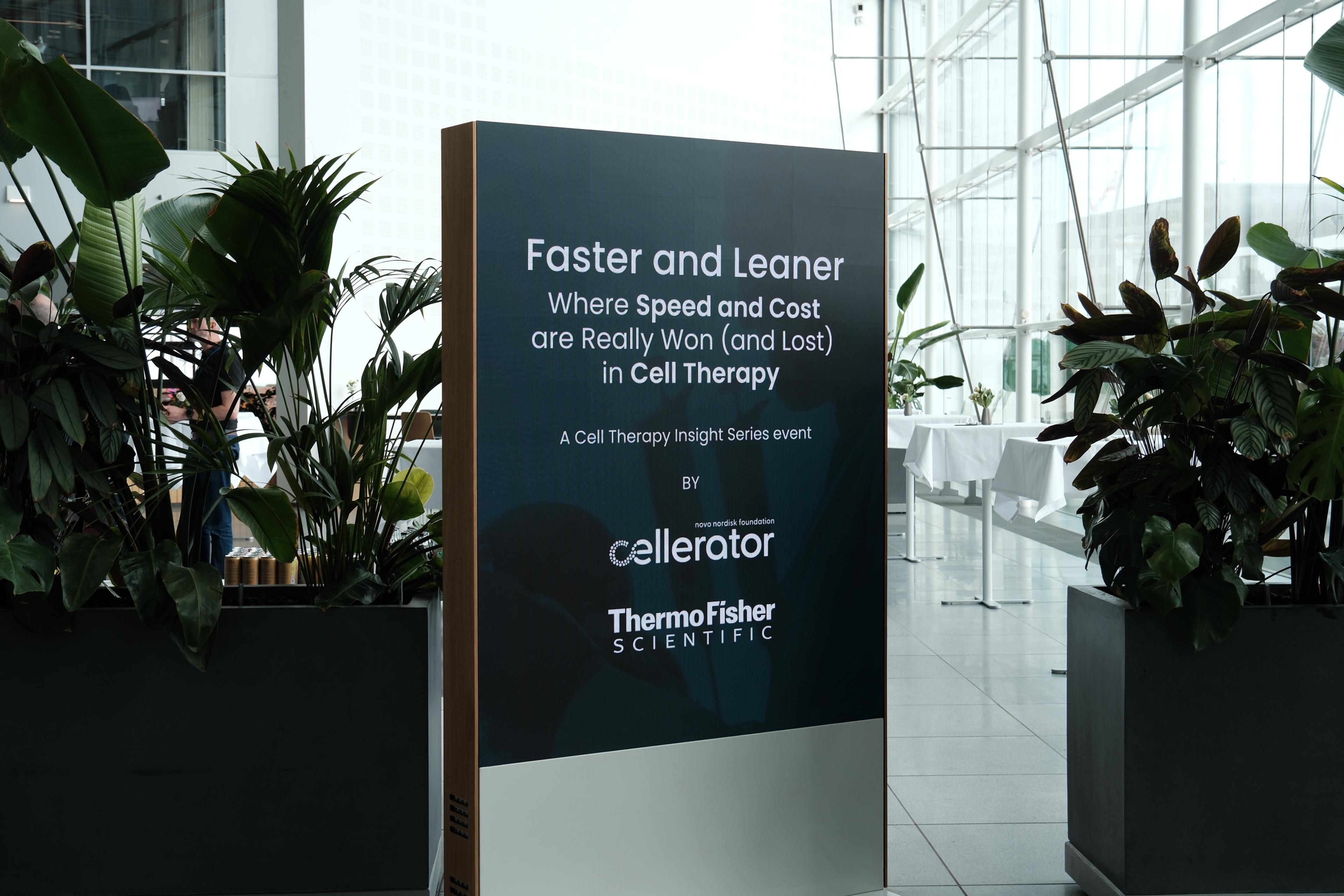
Our fifth Cell Therapy Insights Series event, April 15, addressed a central question: Can we accelerate cell therapies to patients without building cost structures that collapse at scale?
To explore this question, we were joined by 3 leading experts in the field, representing a CDMO, an ecosystem hub, and a start-up perspective, and 180 participants from across the ecosystem.
Together with Thermo Fisher Scientific, the Cellerator hosts the Insights Series twice a year to strengthen the bridge from research to patient access. By bringing together developers, manufacturers, funders, and technology partners, the series aims to share practical lessons from across the ecosystem so promising programmes can move from research to patient impact with fewer resets, delays, and cost surprises.
Fast is engineered early
Angela Osborne (Founder & Executive Chair, Exmoor Pharma Concepts) opened with a message rooted in translation discipline: time and cost are often lost before manufacturing begins.
From her CDMO perspective, drawing on two decades in cell therapy, the biggest accelerators are not necessarily new tools but early decisions that prevent late-stage rework. She argued for a CMC strategy that is defined before process development begins, with the commercial endpoint in view - not only first-in-human. Without that, teams can spend months optimising steps that later prove unaffordable, unscalable, or non-transferable, only to be forced into comparability-heavy rebuilds.
Angela also highlighted the practical mechanics behind “fast”: engaging regulators while choices are still reversible, using cost-of-goods thinking early enough to steer development effort, and treating tech transfer as a people process. She noted that tech transfers often fail on details that never make it into protocols - an issue Exmoor saw sharply during COVID when remote transfer missed a small, unwritten step that determined whether the process worked at all.
Lean only works if it scales
Rosa Canet-Avilés (Chief Scientific Officer, California Institute for Regenerative Medicine, CIRM) brought a hub perspective from California’s regenerative medicine ecosystem. Backed by public funding since 2004, CIRM has supported a large translational pipeline including 116 clinical trials and more than 4,300 trial participants, alongside enabling infrastructure intended to move programmes into early clinical testing.
Her key point was blunt: the transition from academic GMP to industrial scale is not a handoff, it is often a rebuild. Academic processes tend to be manual, expert-dependent, and designed to produce early clinical material - not to support robust, repeatable scale. When programmes move towards later-stage trials, industrialisation and tech transfer require a different level of process discipline, capital, and risk tolerance - particularly for pluripotent stem cell-derived therapies.
In her view, ecosystem infrastructure can accelerate early clinical entry, but without stronger incentives for scale readiness and tighter alignment across sponsors, academics, and CDMOs, the system can unintentionally defer the hardest work. That deferral is what creates the “cost cliff” - a point where programmes face rework, new comparability packages, and manufacturing reinvention precisely when timelines and budgets are least forgiving.
Make change survivable
Terri Gaskell (Chief Technology Officer, Rinri Therapeutics) finished with the start-up reality behind the theme. Rinri Therapeutics is developing an off‑the‑shelf, pluripotent stem cell-derived therapy for hearing loss.
Terri described how Rinri Therapeutics invested early in surgical simulation, cadaver work, and detailed handling studies to avoid a familiar failure mode: reaching the clinic with a product that is biologically promising but operationally fragile. Her talk expanded the definition of “lean” to include the clinical interface: if administration, handling, and site execution are not engineered early, manufacturing progress does not translate into reliable patient delivery or decision-grade clinical data.
Terri’s perspective fed directly into the panel discussion, moderated by Timothy M. Miller (Global Head, Scientific & Therapeutic Development, Thermo Fisher Scientific). One conclusion surfaced repeatedly: change is inevitable. What separates controlled progress from costly resets is comparability readiness - having the potency strategy, robust analytics, and retained samples as processes evolve.
Faster does not mean looser
Although they approached the issue from different perspectives, the speakers ultimately aligned on a clear, practical warning: faster does not mean looser. Insufficient GMP readiness, weak analytics, or poor documentation do not reduce cost - they shift it downstream into delayed submissions, comparability packages, and manufacturing reinvention.
Across all three perspectives, the same prevention strategy emerged: define the CMC endpoint early, design for scale-readiness from the first process choices, and build comparability evidence (potency, analytics, retained samples) before it becomes urgent.
The event concluded with plenty of time for networking, reinforcing a core purpose of the Cell Therapy Insights Series: building a community where practical experience is shared openly, and collective learning reduces repeated mistakes across the ecosystem.
To stay updated on the next Cell Therapy Insights Series event, follow Cellerator on LinkedIn or visit cellerator.dk.
Reach out to hear more