Cellerator and Organization of Future Medicine join forces to strengthen Japan-Europe ties in cell therapy
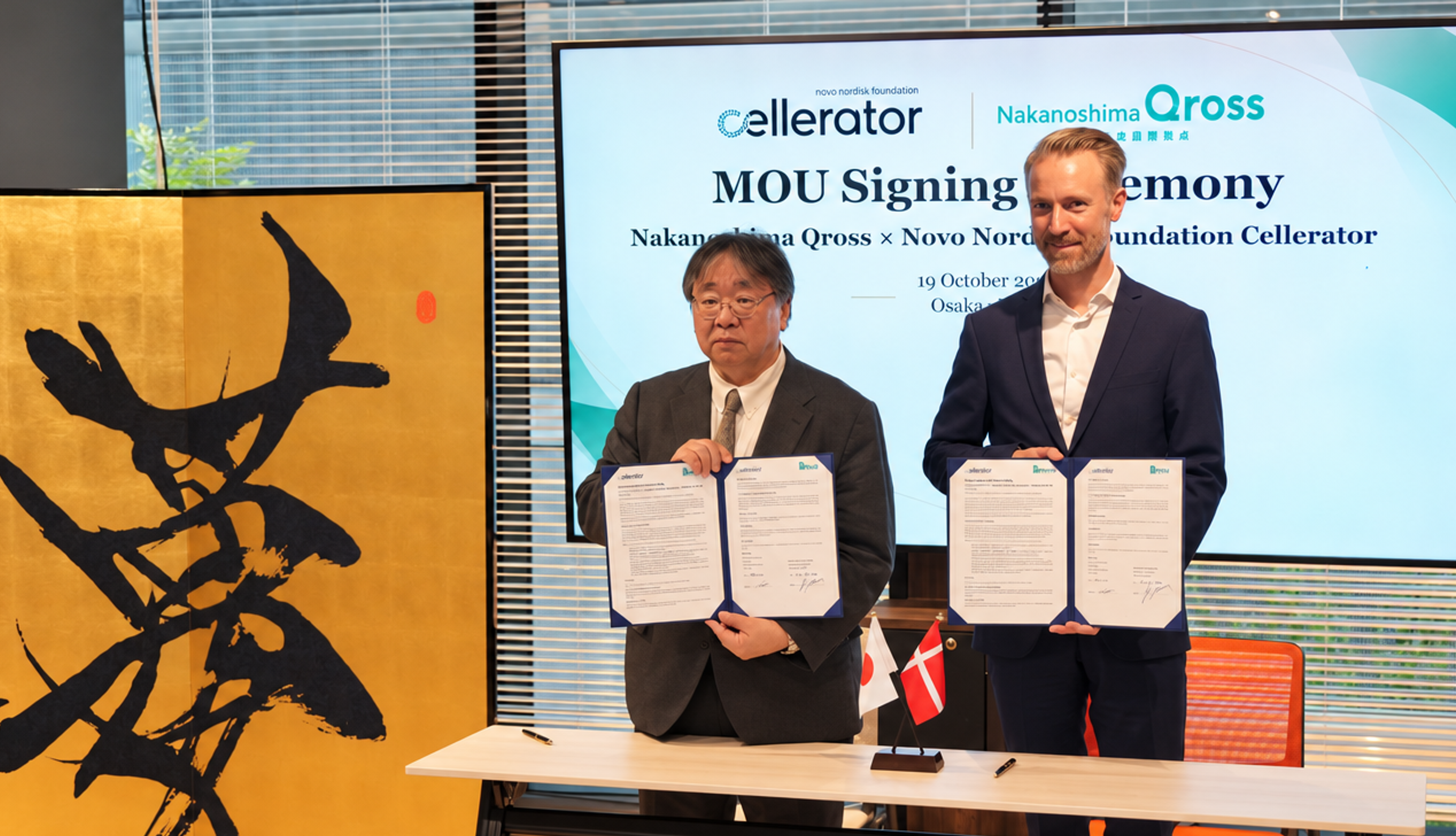
Novo Nordisk Foundation Cellerator and Japan’s Organization of Future Medicine (OFM), which operates Nakanoshima Qross, today signed a Memorandum of Understanding aimed at building closer links between the Japanese and European regenerative medicine ecosystems.
The agreement will connect the organisations’ expertise and networks in Japan and Europe, linking Japan’s regenerative medicine ecosystem with Cellerator’s base in Denmark and the wider Medicon Valley life science cluster. The collaboration will focus on helping novel and promising innovations within the two ecosystems move towards clinical application and industrial development, spanning areas including process development, manufacturing, technology transfer and regulatory approaches.
Few countries have shaped modern regenerative medicine as profoundly as Japan. Twenty years ago, Kazutoshi Takahashi and Shinya Yamanaka at Kyoto University showed that mature cells could be reprogrammed into induced pluripotent stem cells (iPSCs), opening an important new avenue for stem cell research and cell therapy development. Yamanaka later shared the 2012 Nobel Prize in Physiology or Medicine for discoveries concerning the reprogramming of mature cells to pluripotency.
Japan has complemented advances in regenerative medicine with regulatory initiatives designed to support innovative therapies. Since 2014, dedicated frameworks for regenerative medical products, including the SAKIGAKE designation system, have offered measures such as priority consultation and review. In fact, early this year, Japan granted the world’s first conditional approval of iPSC-derived products, including iPSC-derived cardiomyocyte sheet therapy, developed by Cuorips, a startup within Nakanoshina Qross ecosystem.
Denmark and the wider Medicon Valley region bring complementary strengths. A recent analysis commissioned by Novo Nordisk Foundation identified Medicon Valley as one of Europe’s leading bioclusters. The region combines strong research and clinical capabilities with an established life science industry, infrastructure and an environment focused on translating research into new companies and therapies. The same study also ranked Kansai region, where Nakanoshima Qross is located, among the world’s best regenerative medicine clusters, highlighting its strong capabilities of supporting the entire process from translational research to manufacturing.
Combining the strengths of these two unique ecosystems creates an opportunity to build a stronger bridge between Japan and Europe. Through Cellerator and the wider Medicon Valley ecosystem, the collaboration is intended to give organisations in OFM’s network access to relevant expertise, infrastructure and potential partners in Denmark and Europe, while creating new opportunities for European researchers and companies to connect with Japan’s regenerative medicine ecosystem.
“Japan has built an incredibly impactful environment around regenerative medicine, combining pioneering science and clinical translation with a willingness to rethink how transformative therapies are developed and brought towards patients faster,” says Thomas H.R. Carlsen, CEO of Cellerator, and continues: “At the same time, we see an opportunity to create stronger links between Japan and the cell therapy ecosystem accelerating in Denmark and Europe. By connecting our networks and capabilities, we hope to create new opportunities for researchers, companies and innovators ultimately to the benefit for the patients.”
The agreement comes as the field marks 20 years since the discovery of iPSCs, providing a timely backdrop for a partnership focused on the next stage of regenerative medicine: translating scientific advances into treatments that can reach patients.
Cellerator, established with funding from the Novo Nordisk Foundation, is developing a new cell therapy facility at the Technical University of Denmark in Greater Copenhagen. Designed to help bridge the gap between promising discoveries and early clinical trials, the facility will offer all capabilities needed to secure tests in humans from a product development point-of-view. It is expected to become fully operational in 2027 and will serve academic, biotech and pharmaceutical organizations in Denmark and internationally.
For Organization of Future Medicine, the collaboration creates opportunities to connect organizations within its network with expertise, infrastructure and potential partners in Denmark and Europe, while strengthening the exchange of knowledge and experience between the two ecosystems. The MoU specifically envisages cooperation across academia, start-ups, companies and healthcare institutions.
“Novo Nordisk Foundation Cellerator has developed an incredible facility that will accelerate the development of cell and gene therapy products both locally in Denmark and internationally, by providing the required infrastructural, process and technical support thus addressing key challenges that have hindered the clinical development of these products,” says Prof. Dr. Yoshiki Sawa, President and CEO of Organization of Future Medicine. “Similarly, Nakanoshima Qross, and Japan at large has made significant advances in regenerative medicine, both in translational research and regulation. This partnership will therefore combine the unique strengths of Nakanoshima Qross and Cellerator, help accelerate the industrialization of innovations from both Japan and Europe, and contribute to social implementation for the benefit of patients’ unmet medical needs.”
The partnership will initially focus on identifying areas where the two organizations and their networks can work together. The MoU includes plans to explore joint meetings and workshops, visits, training and personnel exchanges, as well as knowledge sharing and opportunities for research and business collaboration. The organizations also intend to introduce potential partners and support matchmaking across their respective networks.
Reach out to hear more